
The Story Behind Windows to Witness
Windows to Witness began with two daughters wanting to honour their mother.
As Judy Schwartz approached her 80th birthday, her daughters, Noa Daniel and Ora Goldin, together with their father, Dennis Schwartz, began imagining a way to recognize the extraordinary contributions Judy has made to the Jewish community and to the broader community around her.
But as they stepped further into the project, its purpose began to grow and deepen.
They realized that perhaps the most meaningful way to honour Judy was not simply to celebrate her work and years of volunteer service, but to honour the people whose stories she had been entrusted to carry forward.
Over the past 40 years, one of Judy’s many roles has been as an interviewer of Holocaust survivors. Through what is now the USC Shoah Foundation, established by Steven Spielberg, she helped document the firsthand experiences of survivors so their voices could continue to educate future generations and help confront antisemitism, hatred, and bigotry.
Judy had what she referred to as the profound privilege of sitting with Holocaust survivors from Hamilton and the Greater Hamilton Area, listening as they shared their lives before, during, and after the Shoah. She recorded 57 of these testimonies for the USC Shoah Foundation, helping ensure that these voices and experiences remain part of our shared human record.
With Dennis’s support, Noa and Ora began a journey to bring these stories home—to create a place in Hamilton where the voices of its own survivors could continue to be heard.
And then they remembered a story their mother had shared with them.
As a young girl, Judy had a terrifying dream. In it, she was standing on one side of barbed wire, looking at a child in a concentration camp.
“I was horrified. Here I was on the outside, looking at this little concentration camp victim. I saw this little girl on the other side...that little girl, it was me.”
Decades later, that childhood dream seemed to hold something of the path Judy would eventually follow: looking through a barrier at someone whose experience she could not turn away from, and feeling called not only to witness but to act—to carry those stories forward, to educate others, and to make a difference in the world around her.
That dream became the window.
Witnessing became a call to action
And from there, the name Windows to Witness was born.
But Windows to Witness had also grown into something much larger than a birthday gift.
What began as a way to honour Judy had become a contribution to the Hamilton community—a way of honouring its past while helping ensure that the stories of its survivors remain accessible for generations to come.
As the project continued to take shape, three interconnected ideas emerged: the power of a single voice, the responsibility of bearing witness through testimony, and what it means to belong to a community and hold responsibility for one another.
These became the three windows through which the story of Windows to Witness is told:
VOICE. TESTIMONY. COMMUNITY.
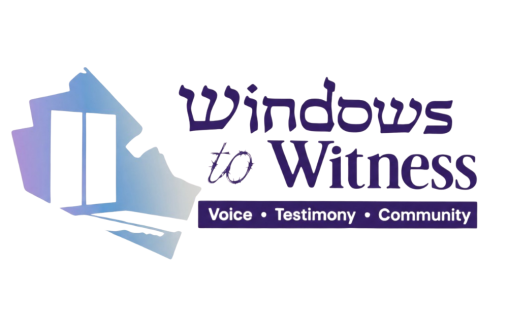
The window itself, as part of the logo, projects the shape of the city of Hamilton.
About the Windows to Witness Installation
Windows to Witness is designed as a symbolic French window installation concealing an interactive touchscreen experience.
At first glance, visitors will encounter illuminated window panels — reflections of home, memory, and the lives that existed before the Holocaust. When opened, the windows reveal access to survivor testimonies recorded by Judy Schwartz for the USC Shoah Foundation.
Through the touchscreen interface, visitors will be able to search survivor names, learn about their lives before and after the Shoah, and hear firsthand accounts in their own voices.
The installation also includes a tribute page dedicated to Judy Schwartz and her lifelong commitment to Holocaust education, Jewish advocacy, interfaith dialogue, and community leadership.
The window itself serves as both metaphor and invitation:
—a window into history,
—a window into humanity,
—and a window into our responsibility to remember.
A window can separate us from history — or invite us to look more closely.
Windows to Witness Logo
The Windows to Witness logo shows the image of a window reflecting the shape of the City of Hamilton, Hebrew-inspired lettering, and barbed wire. Together, these elements interweave Jewish identity, Holocaust memory, and the Hamilton community.
With Gratitude
We are deeply grateful to the creative minds and generous souls who contributed to Windows to Witness including the many creative conversations we had with friends and family throughout this time.
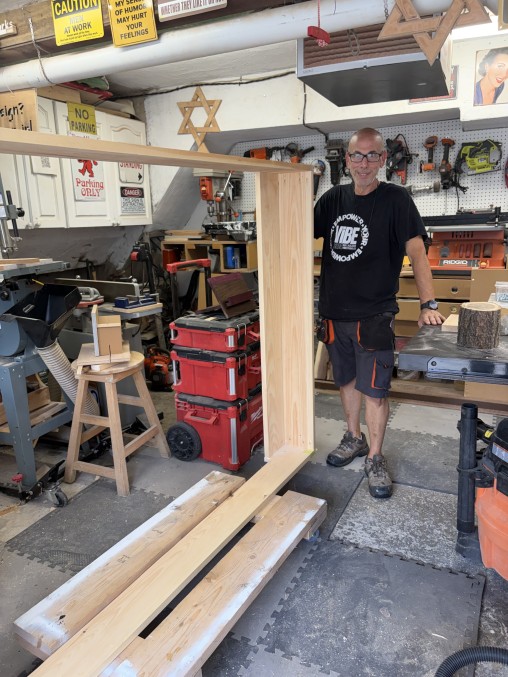
Jeff Ginsberg, Installation Designer
Jeff Ginsberg is the owner and founder of GTA WoodWorks, a Toronto-based woodworking school and makerspace focused on helping people build confidence with tools, materials, and hands-on projects. After more than 25 years working in marketing, technology, and email strategy, Jeff shifted his focus toward teaching practical skills in a safe, supportive, and approachable environment.
Through one-on-one instruction, Jeff works with beginners, hobbyists, DIYers, and experienced makers who want to improve their skills, complete a project, or simply become more comfortable in the workshop. His teaching style is patient, practical, and tailored to each student’s pace and goals.
Jeff was drawn to this project following a 2025 trip to Poland, where visiting concentration camps and speaking with Holocaust survivors reinforced how important it is to preserve and share these stories. Being able to contribute his skills to this memorial is deeply meaningful to him.
Jeff believes woodworking is about much more than building furniture. It is about problem-solving, confidence, independence, and the satisfaction that comes from making something with your own hands.

Jake Zeldin, Logo Designer
Jake Zeldin is a Toronto graphic designer, creative strategist, and mixed-media artist, and Judy Schwartz's cousin. His love of music, creativity, and culture shows in much of his work, as does his drive to make designs that engage people in meaningful ways. When the sisters sent him a few ideas (Hebrew-style font, barbed wire, serious, Hamilton), Jake designed something more meaningful than they could have imagined. Notice the shape of the city of Hamilton around the window, with a reflection that is not a mirror image of the original. There's always something more than one can see. Jake graciously donated his time and talent to design the logo and graphics for Windows to Witness.

Polina Privis, Method Consulting Sign and Print
Polina Privis, president and CEO of Method Consulting Sign and Print, gave her time and her signage and print expertise to produce the plaque and the window designs for this installation. Polina works in large-format print and signage, and she knows what it takes to make an idea visible and lasting. She brought that care to every detail, and helped turn what the family hoped people would feel into something visitors can stand in front of and experience.